
The 9 Most Mysterious Monuments From Around The World
We often spend our days tending to our own small patches of earth, yet the world is full of landscapes and monuments that have been shaped by human hands in ways we still struggle to understand. Exploring these ancient sites still offers a sense of wonder that we can bring back to our own daily lives, so here are eight destinations that continue to puzzle historians and travelers alike.
Göbekli Tepe, Turkey

This site changed how we understand human history. It consists of massive stone pillars arranged in circles, with many pillars featuring carvings of wild animals. It dates back 11,000 years, thousands of years before the invention of agriculture or metal tools. We used to believe that farming led to settled life and then religion, but this site suggests that the urge to build and worship might have come first, having been built by hunter-gatherers who had incredible organizational skills.
The Plain of Jars, Laos

This landscape is scattered with thousands of giant stone jars, appearing in clusters across the Xieng Khouang plateau. Some of the jars are as tall as ten feet! Archaeologists believe they were used for burial practices or perhaps to store food. The jars date back to the Iron Age, though the exact method of carving and transporting them remains unknown. It's a haunting and beautiful site with endless speculative potential.
Newgrange, Ireland

Newgrange is a grand passage tomb built during the Neolithic period. It's older than both Stonehenge and the Egyptian pyramids. The structure is a large circular mound with a stone passageway inside, and the engineering is extremely precise. Above the entrance sits a special opening called a roof box. On the winter solstice, a beam of sunlight shines through this box and illuminates the inner chamber. It shows a sophisticated understanding of astronomy and light that rivals modern architecture.
Yonaguni Monument, Japan

The Yonaguni Monument is a submerged rock formation off the coast of the Ryukyu Islands in Japan. It looks like a stepped pyramid with straight edges and right angles. Divers discovered it in the 1980s, but even today, scientists argue over whether it is man-made or natural. Some geologists believe strong currents carved the sandstone, while others see tool marks and specific architectural features. It is a fascinating place where the line between nature and human creation blurs completely.
The Carnac Stones, France

Imagine planting seeds in perfect rows that stretch for miles. This is what the ancient people of Brittany did with thousands of massive granite stones. There are over 3,000 standing stones arranged in parallel lines across the French countryside, dating back to the Neolithic period. We still don't know if they were a calendar or a religious site, but walking among them feels like strolling through a garden of rock that has been tended for centuries.
Ggantija Temples, Malta

The Ggantija Temples are older than the pyramids of Egypt and sit on the island of Gozo in the Mediterranean. The name means "Giant's Tower" in Maltese, as folklore says a giantess built them while holding her baby. The limestone blocks are massive and weigh several tons each, and the temples themselves have a cloverleaf shape that are said to mimic the curves of the earth. It is a rugged and earthy site that feels very connected to the cycles of nature.
The Blythe Intaglios, California
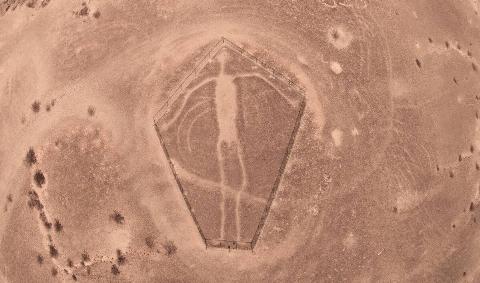
If you travel to the Colorado Desert, you might miss these figures if you don't know where to look. They're giant geoglyphs scraped into the hard desert floor, the figures drawn representing humans and animals. The largest human figure is over 170 feet long. They were likely created by Mojave ancestors, where the creators removed the dark top layer of pebbles to reveal the lighter soil underneath and did so in massive, complex patterns.
Silbury Hill, England

We usually assume a large hill is natural. Silbury Hill is actually the largest man-made mound in Europe. It stands about 130 feet high near Avebury. It's made of chalk and clay, and the builders constructed it in layers around 2400 BC. Unlike a lot of man-made hills, there is no burial chamber inside, so its purpose remains a complete riddle to this day.
The Dolmen of Menga, Spain

This is one of the largest megalithic structures in Europe, located in Antequera. The builders used enormous stone slabs to create a long burial chamber. The roof slab alone weighs 180 tons! They then covered the stone structure with earth to form a hill. The entrance aligns with a nearby mountain shaped like a human face, showing a thoughtful integration of construction and the natural horizon, but for what reason? We still don't know.
These destinations prove that some mysteries really can last a lifetime, and sometimes even the most dedicated researchers can't determine exactly why something was built. They also show us the diverse ways humans have worked with stone and soil throughout history. Many things have changed over the years, but some things always stay the same.