
The Amazing Anaweka Canoe – Found After 600 Years
Many of us love to get out on the water in our canoes. The world can seem a different place when we're gliding across the the middle of a tranquil lake or calm seas. What we do today is just a reflection of the many accomplishments of some of the oldest sea fairing people.
The ancestors of modern day Polynesians traveled over the open ocean in dugout canoes and settled the islands of East Polynesia. These remarkable seafarers who sailed off with just the sun, moon and stars to guide them crossed fantastic distances and found new colonies on hundreds of islands. What they did was amazing.
The Waka

Researchers have researched into the kind of vessels used to cross the oceans, and in recent years they recovered a maritime artifact that is incredibly precious.
In 2012, a family on a picnic made an incredible discovery. They stumbled across a long hull section of an ancient canoe. Then, they called in the experts. Dr. Dilys Johns and a team from Auckland University went to the dunes of a remote bay in the northwest of South Island, New Zealand, where part of a canoe had been uncovered by storm activity.
When it was found

The nearly 20 foot (6mt) length or section of the canoe was found on its own poking out of a sand dune at the mouth of a freshwater stream. There was nothing else around it, no other artifacts were found to give any clue as to how this magnificent canoe came to rest on this sandy bank near the Anaweka estuary.
What does it look like?

The wood of the canoe was identified as coming from the New Zealand matai, (Prumnopitys taxifolia) and the boat appears to have been carved from a single tree, which was carbon dated to approximately 1400 AD. There is a beautiful sea turtle carved on the side, connecting this canoe to Polynesian art and culture.
What it's going to be used for

This canoe will be studied and will provide valuable information into the construction and materials used for seagoing canoes by the ancient Polynesian peoples. It had holes chiseled into the wood designed to work for lashing.
The inside of the vessel shows rough adze cuts, but the outside has been smoothed to allow for easy movement through the water.
New ribs
A remarkable feature of the vessel is the four transverse ribs that had been carved into the hull and the one longitudinal girder running along the entire length of the hull. Previously, the use of ribs in the construction of canoes was unknown in this part of New Zealand.
What did it used to look like?
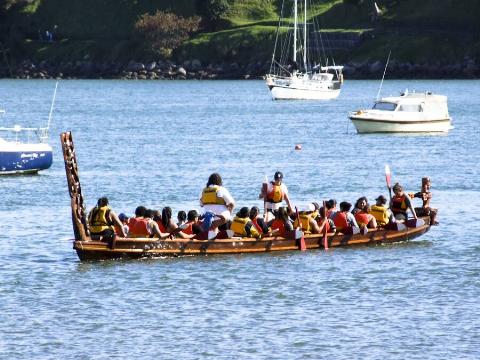
This robust, sophisticated canoe was part of a larger vessel. It would, almost certainly, have been equipped with a sail and was possibly a part of what was originally a multi-hull vessel.
Once again, we have to be in awe of the technical skills of our ancestors. They didn't only make complicated maritime vessels, but they also sailed them into the unknown, going on to colonize parts of the globe that European nations didn't know about yet.
We live in a beautiful world, get out there and enjoy it.
Outdoor Revival - Reconnecting us all with the Outdoor